
작은 카메라로 더 넓고 선명하게 볼 수 있을까?How can a small camera see more?
카메라는 물체에서 온 빛을 렌즈로 모아 센서 위에 영상을 만듭니다. 더 넓은 장면을 담으려면 비스듬히 들어오는 빛까지 다뤄야 하고, 어두운 곳에서는 센서에 도달하는 적은 빛을 잘 활용해야 합니다. 픽셀 수를 늘리는 것만으로 해결하기 어려운 문제입니다.
렌즈의 모양과 조리개, 센서의 곡률과 흡수층은 모두 영상에 영향을 줍니다. 자연의 시각에서 발견한 설계 원리도 공학적인 렌즈와 반도체 센서로 옮길 수 있습니다. 핵심은 어떤 빛을 모으고, 어디에 초점을 맺으며, 얼마나 잘 검출하는지 함께 설계하는 것입니다.
A camera forms an image by gathering light from a scene onto a sensor. A wider view requires handling light arriving at oblique angles; a darker scene requires making good use of scarce light. More pixels alone cannot solve either problem.
The lens shape, aperture, sensor curvature and absorbing layers all influence the image. Principles found in natural vision can also be translated into engineered optics and semiconductor sensors. The central task is to design what light is collected, where it comes to focus and how well it is detected.
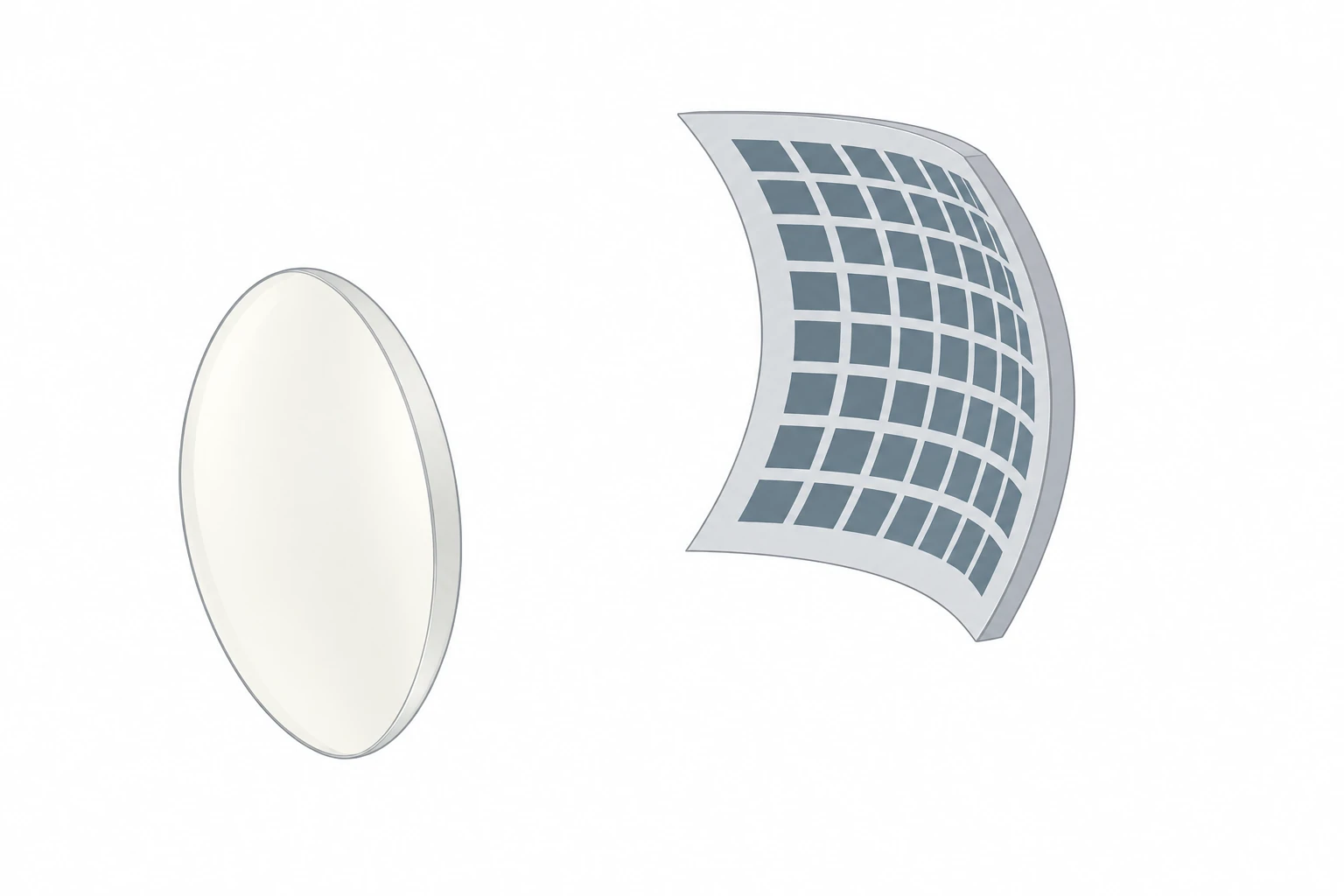
- 시야각Field of view
- 카메라가 한 번에 담는 장면의 각도입니다. 넓은 시야를 얻으려면 가장자리로 들어오는 빛도 고려해야 합니다.The angular extent of a scene captured in one image. A wide view requires careful handling of light from the edges of the scene.
- 초점과 센서 형상Focus & sensor geometry
- 렌즈가 선명한 상을 맺는 면은 반드시 평평하지 않습니다. 초점면과 센서의 형상을 맞추는 것도 설계 방법입니다.The surface on which a lens forms a sharp image is not always flat. Matching the sensor to that focal surface offers another design approach.
- 빛의 수집과 검출Light collection & detection
- 렌즈가 모은 빛도 센서에서 흡수되어야 신호가 됩니다. 흡수층과 반사층의 설계는 빛의 활용도를 바꿉니다.Collected light must be absorbed in the detector to produce a signal. Absorbing and reflective layers influence how effectively it is used.
PIXEL에서 탐구하는 질문Questions we explore at PIXEL
관련 연구에서는 렌즈와 센서를 하나의 이미징 시스템으로 다룹니다. 하나의 중심을 공유하는 구면 광학 구조인 단심 렌즈와 반구형 광다이오드 어레이를 결합해 넓은 시야를 구현했고, 다른 연구에서는 검출기 뒤의 반사층으로 빛을 다시 활용했습니다. 광학 설계가 센서 제작과 연결될 때 어떤 영상이 가능해지는지 탐구합니다.The related studies treat the lens and sensor as one imaging system. A monocentric lens, whose spherical optical surfaces share a common centre, was paired with a hemispherical photodiode array for wide-field imaging. Another study placed a reflector behind the detector to reuse transmitted light. Together, they connect optical design with the physical construction of an image sensor.
함께 시작할 수 있는 연구Where you could begin
카메라·로봇·영상 기술에 관심이 있다면, 광선 추적과 간단한 렌즈 실험부터 시작할 수 있습니다. 같은 장면이 렌즈와 센서 설계에 따라 어떻게 달라지는지 비교하며 기하광학, 소자 제작, 영상 분석을 연결해 볼 수 있습니다.An interest in cameras, robots or imaging can begin with ray tracing and simple lens experiments. Comparing the same scene across lens and sensor designs connects geometrical optics, device fabrication and image analysis.
논문으로 만나는 연구Explore the research through our papers
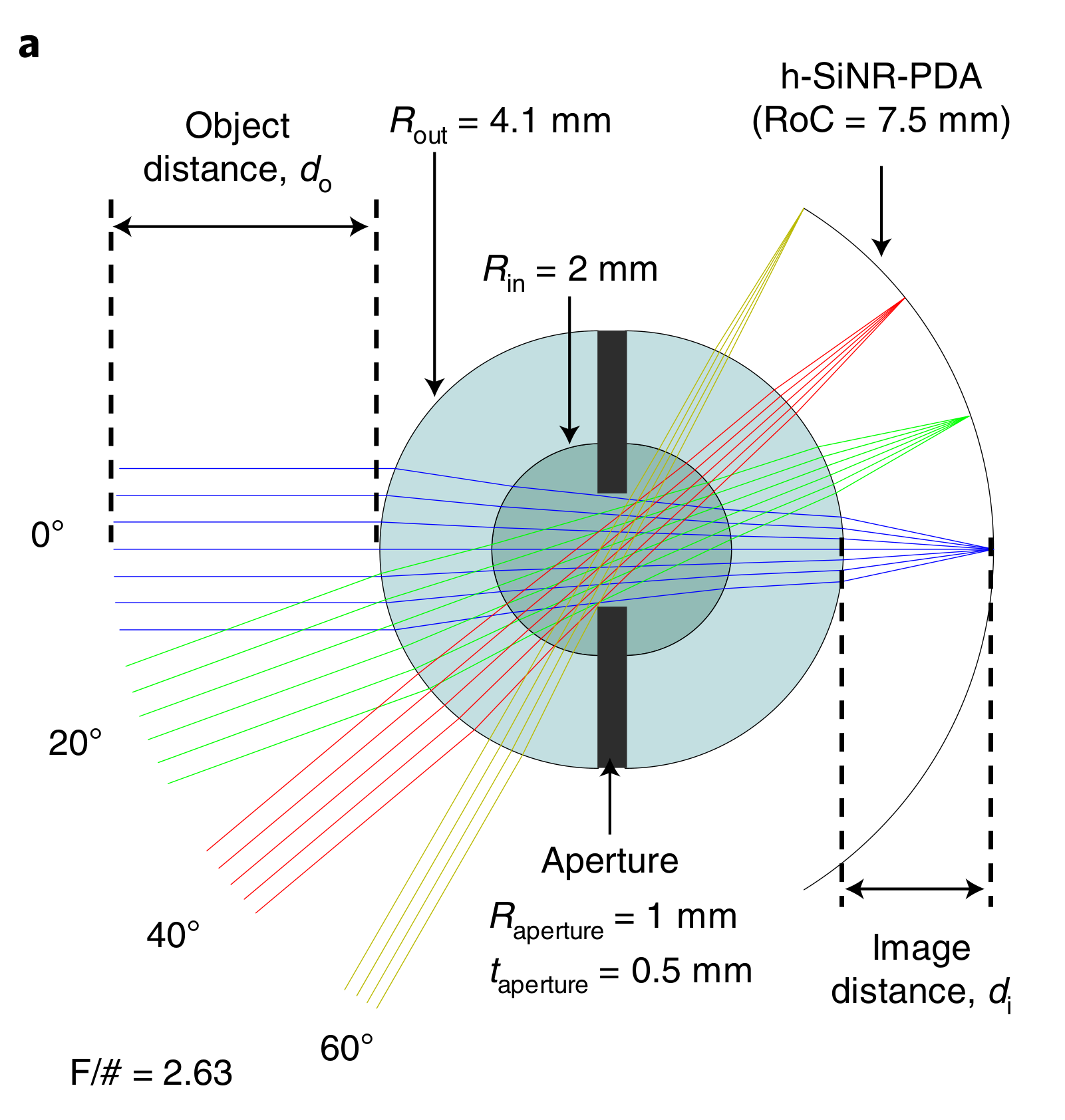
곡면 센서와 렌즈를 함께 설계한 광시야 카메라A wide-view camera built around a curved sensor
단심 렌즈와 반구형 실리콘 나노막대 광다이오드 어레이를 결합했습니다. 렌즈의 초점면에 맞춘 센서 형상으로 넓은 시야를 구현한 연구입니다.A monocentric lens was combined with a hemispherical silicon-nanorod photodiode array, demonstrating wide-field imaging by matching sensor geometry to the lens’s focal surface.
Nature Electronics 3, 546–553 (2020)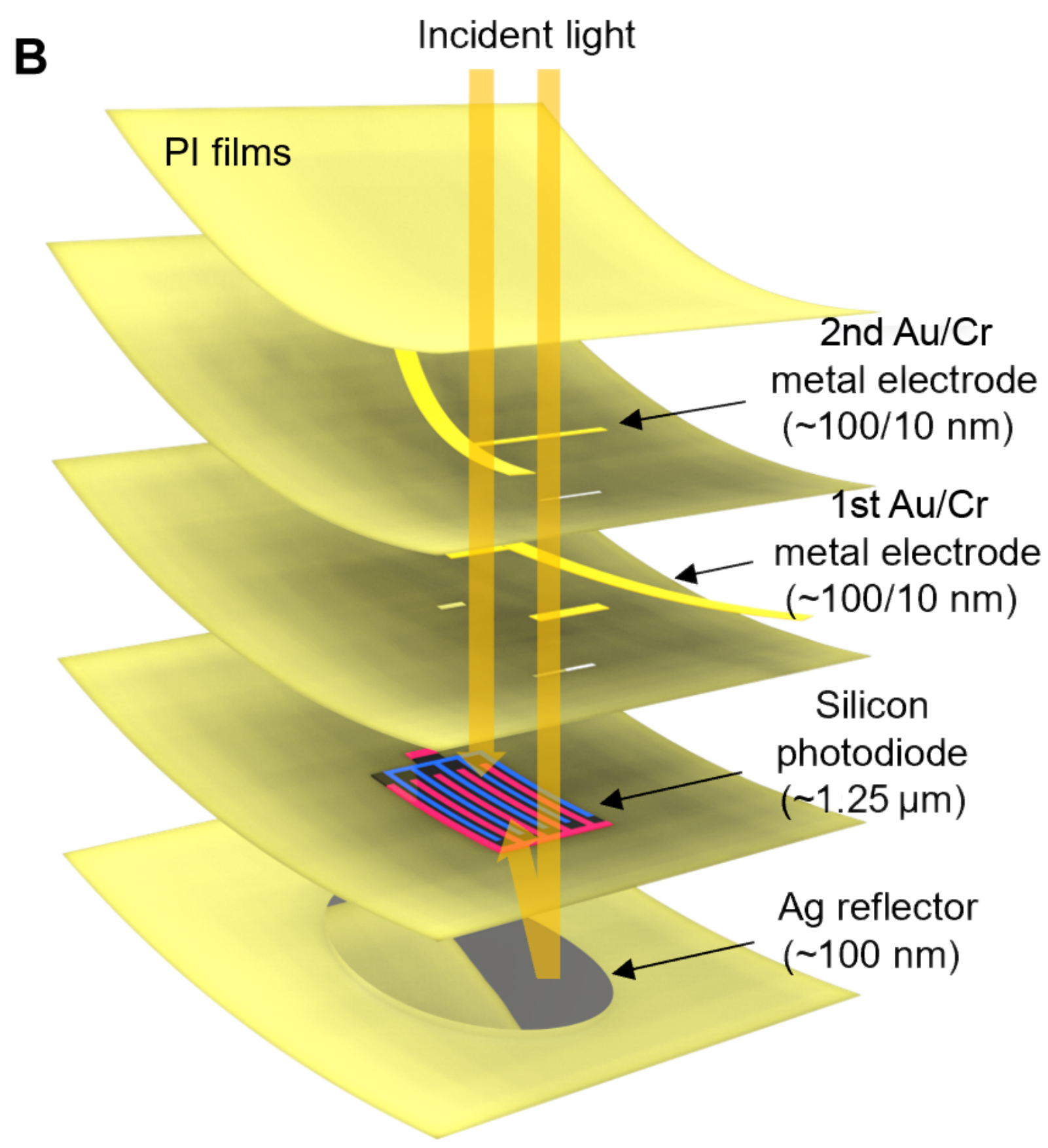
반사층으로 빛을 다시 활용하는 인공 시각Artificial vision that gives light another pass
광검출기 뒤에 은 반사층을 두어 통과한 빛이 다시 검출층을 지나도록 했습니다. 다양한 조명에서 물체를 구별하기 위한 인공 시각 시스템에 이 원리를 적용했습니다.A silver reflector behind the photodetector returns transmitted light through the detecting layer. This principle was incorporated into an artificial vision system for distinguishing objects under diverse lighting.
Science Advances 10, eadp2809 (2024)Related publications
-
Science Advances 10(38), eadp2809 (2024) (link)
Co-first author
-
Avian eye-inspired perovskite artificial vision system for foveated and multispectral imaging
Science Robotics 9(90), eadk6903 (2024) (link)
Co-first author
-
Science Robotics 8(75), eade4698 (2023) (link)
-
An amphibious artificial vision system with a panoramic visual field
Nature Electronics 5(7), 452-459 (2022) (link)
-
Vari-focal light field camera for extended depth of field
Micromachines 12(12), 1453 (2021) (link)
Co-first author
-
Micromachines 11(12), 1068 (2020) (link)
-
An aquatic-vision-inspired camera based on a monocentric lens and a silicon nanorod photodiode array
Nature Electronics 3(9), 546-553 (2020) (link)
Co-first author
-
Miniaturized 3D depth sensing-based smartphone light field camera
Sensors 20(7), 2129 (2020) (link)
Co-first author
-
Large area fabrication of engineered microlens array with low sag height for light-field imaging
Optics Express 27(4), 4435-4444 (2019) (link)
Co-first author